生物经济在加拿大(in English)
The bioeconomy development in Canada
1 Canada's Voice for Bioeconomy(加拿大对生物经济的理解)
The bio-economy is the result of harnessing biotechnology processes, products and tools and applying these in diverse fields: the production of medical treatments, diagnostics, foods, energy, chemicals, and industrial materials. The bio-economy refers to the application of life sciences (biotech) technologies into the traditional economy.
International economists believe the bio-based economy is responsible for as much as one-third of the global economy. According to the OECD, the bio-economy will contribute 10-14 new drugs per year over the next 5 years, and will be responsible for 10 % of chemical production by 2030.
This application of biotechnology is revitalizing established Canadian industries. In healthcare, automotive, agriculture, forestry and even traditional manufacturing, biotechnology provides options for more efficient, greener and cleaner products and processes such as:
· car seat foam made from soybeans,
· bio-diesel
· bio-pesticides made from pest-killing viruses
· engine oils made from oilseed crops,
· biological therapies for Alzheimer’s or cancer,
· new plastic composites from agricultural sources,
· trans fat-free cooking oil,
· renewable biomass energy sources
· vaccines
What do compostable plastic bags, cold water laundry detergent and life-saving vaccines all have in common? They are all biotechnology products that make our lives healthier, safer, cleaner and better.
Biotechnology products, process and technologies that are ubiquitous across our economy: in health, agriculture, environment, manufacturing, resource management, and energy.
2 How is Canada's Bioeconomy Development(加拿大生物经济发展状况)
Today, our research estimates that Canada’s bio-economy is worth $86.5 billion, or more than 7% of Canada's annual GDP. This is significant as it is greater than the impact of the auto and the aerospace industries on the economy. There are over 1 million Canadians working throughout the bio-economy employment network. Its future growth potential is even greater.
Understanding the bio-economy facilitates the right financial, policy, and regulatory frameworks, enabling the integration of biotechnology and renewing traditional industries. Building this bio-economy here in Canada is a clear economic imperative leading to a path of job creation and prosperity in an increasingly bio-based generation.
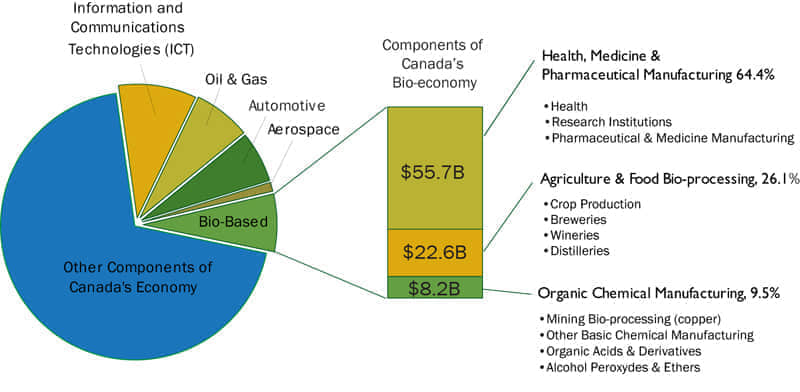
Canada has a strong and vibrant biotechnology industry contributing great value to our economy and quality of life. As an early leader in the commercial development of biotechnology products, including vaccines and canola, Canada has established international credibility for the ingenuity of this industry.
Since 2007 the bio-economy industry has steadily increased. It started at $78 billion. For 2011 is valued at $87.3 billion. This translates to a growth of 12% over the last 4 years. Countries everywhere are eagerly looking to build what Canadian biotechnology has achieved and is continuing to build.
Emerging economies throughout South America, Asia and Eastern Europe are rapidly seeking to catch up to the established bio-economy success of Canada. With all levels of Canadian governments working to build the competitive environment for our technologies to thrive, our industry stands proudly as one of the key economic drivers of the Canadian economy.
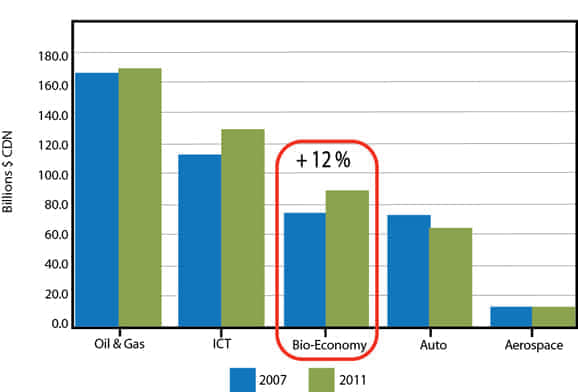
Fig.2 Canadian Industry Sectors GDP- The $87.3 Billion Canadian Bio-Economy
Many people don’t realize how biotechnology touches our economy in various ways. Canada has a remarkable experience and expertise, with over 500 companies and thousands of innovations. Biotechnology has much to offer in building a bio-economy.
3 The Canadian Bioeconomy Blueprint(加拿大生物经济蓝图)
Canada’s biotechnology industry is an economic driver for our current and future economy. Over 550 biotech companies in health, agriculture, industrial manufacturing and resources are creating products and processes that are the building blocks of a broader bio-based economy.
Canada’s bio-based economy is worth $86.5 billion, more than 7% of our GDP – and supports over 1 million Canadian jobs through the bio-economy employment network. Its future growth potential is even greater.
Biotechnology is creating products and processes that improve our quality of life. Just as importantly, biotechnology is also creating high-quality jobs for Canadians in every part of the country; rewarding, knowledge economy jobs.
The Canadian Blueprint: Beyond Moose and Mountains is Canada's biotech industry strategy to take full advantage of all the opportunities biotechnology has to offer. This document is a call to action. The Blueprint is vitally important because, the fact is, biotechnology is critical to Canada’s future prosperity and economic security.
However, as strong as it is, biotech is also quite vulnerable to foreign competition. Given biotechnology’s tremendous potential, global competition is fierce. More and more countries are aggressively investing to build their biotechnology portfolios and strengthen their economies. Canada’s current top-ten position is now slipping.
The Canadian Blueprint will change this. If all of us – industry, governments, academia and ordinary Canadians – pull together, we will reverse Canada’s slide, and put our country on track to become the world’s leading bio-based economy.
Edited by The Research Center for Bioeconomy Development (RCBED)
For more details, we can visit: http://www.biotech.ca/en/what-biotech-is/bio-economy.aspx