The Origin and Development of the Concept “Bioeconomy”
DENG Xin-an
(The Research Center for Bioeconomy Development (RCBED), China Agricultural University, 17 Qinghua Donglu, Haidian District, Beijing 100083, China)
Key words: life sciences and biotechnology; bioeconomy; the bioeconomy era (the bioec era)
1. The early formal definitions of bioeconomy
The formation of the concept and development view of bioeconomy is promoted by the rapid development of life sciences and biotechnology. As the utilization of biotechnology goes through a long history, the R&D and industrialization related to bioeconomy has gone through a quite long history. But as a corresponding economic formation with agriculture economy, industrial economy, information economy, the bioeconomy is still quite a new concept. Juan Enriquez thought that the new discoveries and their applications of genomics would lead to the molecular-genomics revolution, which would make chemical, medical, pharmaceutical, agribusiness, health and nutrition, cosmetics, energy, and environmental companies restructure and merge, and than would change fundamentally the world's economy[1]. The “bio-based economy” and “biobased products” had been put forward in 1999 based on the latest development of life sciences and biotechnology and the ever-increasing needs for the bioenergy and sustainable industrial raw materials[2]. Based on a systematical exploration and comparative studies of the passed economic formations, Deng Xin-an defined bioeconomy as an emerging economic formation, which is corresponding with agricultural economy, industrial economy and information economy, based originally on the R&D and application of the life sciences and biotechnology, and built directly on the bioproducts and bioindustries[3,4]. Wang Hong-guang defines bioeconomy as an economy built on bioresources and biotechnology, based on the production, allocation, and application of the bioproducts[5]. European Commission put it as “the knowledge-based bio-economy”(KBBE)with an abbreviated term bioeconomy. The bio-based economy is a term which encapsulates our vision of a future society no longer wholly dependent on fossil fuels for energy and industrial raw materials[6]. The OECD project supposes the bioeconomy to be the aggregate set of economic operations in a society that use the latent value incumbent in biological products and processes to capture new growth and welfare benefits for citizens and nations[7].A common point of above definitions is, the formation and the development of bioeconomy is produced to by R&D for life sciences and biotechnology.
2. The opportunity of the bioec era
The formation of the concept and development view of bioeconomy is the symbol of the approach of the bioeconomy era (abbr the bioec era). The economy era means the specified period when a certain economic formation grows to maturation and dominates the economic society, and thus names after the corresponding economic formation. A certain economic formation comes into maturation indicates that the economic society had been entered the corresponding economy era. The economic society has gone through the hunting & gathering economy era (abbr H&G Ec), the agricultural economy era (Agrarian Ec), the industrial economy era (Industrial Ec), and the information economy era (Info Ec), and now is enter the growth phrase of bioeconomy (Bioec). Stan Davis etc. divided bioeconomy into four phrases including gestation, growth, maturity, and decline; symbolized by the discovery of DNA double helix in 1953 and the human genome decoding in 2000, the economic society had stepped respectively into the gestation and growth phrase of bioeconomy[8]. Judging from the facts of popularization of the bioproducts’ application and the fossil resources(mainly petroleum) exhaustion, the economic society will develop into the maturity phase of bioeconomy in the late 2020s, which means entering the “real” bioec era (Fig.1) [8,9].
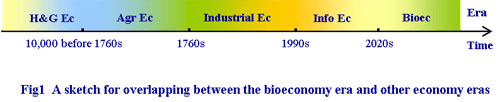
Facing the upcoming bioec era, the strategies and policies have been conducted in EU, US, and China et al. A tidal wave of researches on the developmental strategy and policy for bioagriculture, biofuel and biorefinery is upsurging in the interaction of sci-tech circle and economy circle multi-levelly. For example, a conference named knowledge-based bio-economy was launched in EU in 2005 and EU has built a series of bio-economy platforms, which are Plants for the Future, the Biofuels Technology et al.[10] The Bioeconomy Institute (BEI) in Iowa State University put agriculture and renewable resources as its research objectives and focus its research on the renewable bioresources as raw materials to produce chemicals, fuels, materials and other energies.
In accordance with the four major challenges facing the mankind, which are food and nutrition, renewable energy and sustainable raw material, environmental sustainability, human health, the bioeconomy will change the modes of production for “4fs” (food, feed, fuel, fiber) and bring transform to the new agriculture development view[11,12,13]. A R&D frontier fields have been set up by developning bioeconomy, and the innovative application of agricultural biotechnology can change the economic model of the produces from the perspective of end-user level and value-added bioproducts, and by doing so, transforming the foundation of industrial economy and stepping towards carbohydrate-based economy[14,15,16]. The revolutionary influence to genetically modified plants and biofuels by life sciences and biotechnology is leading the transformations of the new agriculture view and of agriculture as well. That is to say, agriculture is probably “transition to an agriculture that produces biomass as well as food and fiber”[17]. Based on the revolutionary influence to agriculture by life sciences and biotechnology, some scholars put forward an assumption of building new agriculture system(NAS) based on bioeconomy[3,18].
References
[1]Juan Enríquez. GENOMICS: Genomics and the World's Economy. Science, 1998,281(5379):925-926
[2] DENG Xin-an,FENG Ying and ZENG Hai-yan. On the Strategy of the Bioeconomy Development. China Biotechnology, 2010,30(10):125-131 (in Chinese)
[3] Deng Xinan. The Bioeconomy Era and the New Agriculture System, Forum on Science and Technology in China, No.2(2002),pp.16-20 (in Chinese)
[4] Deng Xinan and Gao Lu. The Developmental Phases and Marking Events of Economy Eras, Forum on Science and Technology in China, No.2(2006),pp.111-114+70 (in Chinese)
[7] Paris OECD Headquarters,THE BIOECONOMY TO 2030:DESIGNING A POLICY AGENDA. Scoping Paper,2006-3-6
[8] Stan Davis, Christopher Meyer. What will replace the Tech Economy.Time,2000,155(21):76-77
[9] Deng Xinan. Analysis on the endo-driver of Agriculture Expansion in Bioeconomy Era, Impact of Science on Society,No.3(2007),pp.8-12 (in Chinese)
[10]EuropaBio. About the Bio-based economy.http://www.bio-economy.net/,2008-10-20
[11]Gale Group.Convergence of IT and Biotechnology Driving New Revolution in Agriculture. Business Wire, 2007,May 7
[12]Chapotin SM, Wolt JD. Genetically modified crops for the bioeconomy: meeting public and regulatory expectations. Transgenic Research, 2007,16(6): 675-688
[13]Duchesne LC, Wetzel S. The bioeconomy and the forestry sector: Changing markets and new opportunities. Forestry Chronicle, 2003,79(5): 860-864
[14] Sano M. Shimoda. BioEconomy: a new frontier for agriculture. Agri Marketing, 2003,41(6):6-7
[15]Brumbley SM, Purnell MP, Petrasovits LA, et al. Developing the sugarcane biofactory for high-value biomaterials. International Sugar Journal, 2007,109(1297):5
[16]Jenkins T. Toward a biobased economy: examples from the UK. BIOFUELS BIOPRODUCTS & BIOREFINING-BIOFPR, 2008,2(2): 133-143
[17]Iowa State University. Will A Bioeconomy That Produces Fuel From Biorenewable Resources Be Sustainable. ScienceDaily 5 September 2007. 19 January 2010 http://www.sciencedaily.com/releases/2007/08/070830163124.htm
[18]DENG Xin-an and ZENG Hai-yan. The Origin and Development of New Agriculture System, Journal of Agricultural Science and Technology, 2009,11(3), pp.40-45 (in Chinese)