农业与生物经济的可持续性
Will A Bioeconomy That Produces Fuel From Biorenewable Resources Be Sustainable?
http://www.sciencedaily.com/releases/2007/08/070830163124.htm
据www.sciencedaily.com网站2007年9月5日报道,依照美国农业部的估计,今年春天,农民为了满足乙醇工业对谷物的需求,谷物的耕地面积较去年增长了19%。
如果明年再发生这样的情况怎么办?如果农民决定抵制谷物轮作,在同一块地上年复一年地种植玉米怎么办?又或者,如果农民开始种植生物燃料所需谷物,如可从其植物纤维中提取乙醇的柳枝稷,那又将怎么办?土壤会不会失去肥力?侵蚀作用会不会增加?用于生产生物燃料的能源需求量是增加还是减少了?农场的收益是提高还是降低了?生物经济是可持续的吗?
美国爱荷华州大学农业和生物系统工程副教授兼爱荷华州生物可再生计划办公室副主任罗伯特•安勒克斯正在从事相关研究,以回答以上这些问题以及其它的有关农业转型问题,即农业可能转型为既生产生物燃料又生产食物和食用纤维的现代农业。
(Robert Anex, an Iowa State associate professor of agricultural and biosystems engineering and associate director of Iowa State's Office of Biorenewables Programs, is working to answer those and other questions about the transition to an agriculture that produces biomass as well as food and fiber.)
图注:美国爱荷华州立大学农业和生物系统工程副教授罗伯特•安勒克斯正在检查一块地上的高粱-苏丹草的杂交品种。这是一种具有高产率生物质的谷物,可能成为用于生产乙醇的生物原料。爱荷华州立大学的研究人员正在利用这种植物进行一项双重谷物试验:他们在夏季种植高粱-苏丹草杂交品种,冬季种植小麦-黑麦的杂交品种小黑麦。这样,那块地就能提供两种谷物,既更充分地利用了太阳能又减少了侵蚀。
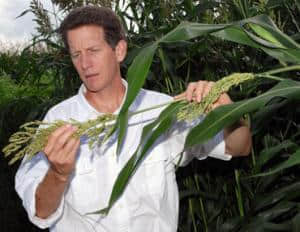
Robert Anex, an Iowa State associate professor of agricultural and biosystems engineering, examines a plot of hybrid sorghum-sudangrass. The plant is a high-yielding biomass crop that's being studied as a possible biomass source for the production of cellulosic ethanol. Iowa State researchers are conducting a double-crop experiment with the plant: They're growing hybrid sorghum-sudangrass in the summer and growing triticale, a wheat-rye hybrid, over the winter. That would provide two crops, capture more solar energy and reduce erosion. (Credit: Bob Elbert)
答案之一:美国农业可能会发生改变
除安勒克斯之外,研究文章的合著者还有:来自爱荷华州农艺部门的安德鲁•希金托勒尔和马特•列博曼,以及达特茅斯学院的李•林德和马克•莱塞尔。他们称:“很可能发生的是,基于生物燃料的谷物生产系统的发展会给农业带来意义深远的影响,它同样也会对能源安全和全球气候造成一定的影响。这是一种积极的影响或是一种消极的影响将在很大程度上依赖于如何对生物燃料的原料进行生产和转换,而且还依赖于这两种综合行为所涵盖的范围”。他们的研究文章“通过联结农业和生物能源系统加强营养物循环的潜力”被发表在最近出版的《作物科学》杂志上。这是美国农作物学会的官方刊物。
文章指出,谷物所需的78%的氮肥可通过一种综合的生物学和热化学过程得以恢复。这一过程可将柳枝稷转化为乙醇。该项研究称,这样的营养恢复和循环能很大地提高生物燃料生产的可持续性,同样也会增加从植物纤维生产乙醇的能源量。
研究人员称,营养恢复可能通过这种方式进行:即植物纤维将通过预处理和发酵被转化为液体燃料。发酵的副产品将被干缩和加热以便从固体变成气体。这种气化过程可以将植物养分留在剩下的灰和氨水里。存在于两种状态中的养分都可得以恢复和回到田里,再用以生产生物燃料。
营养循环的潜在意义在于一种新型农业可以为可持续生物经济“供料”。研究人员在文章中写道:“通过为农业产品制造一种庞大的、新的国内需求,生物燃料转化为乙醇将达到工业规模,其它工业原料也可能会对农业系统的设计造成巨大的影响。从精炼厂到生产原料农业系统实现营养成分循环的可能性将使可持续性和生物效率得到实质性的提高。”
但是,持续的生物燃料生产是一种复杂的系统,它需依赖于许多可变因素如土壤类型、坡地、土壤有机质以及实际收获的生物原料的数量。为了帮助农民逐渐了解从他们的田地里收集生物原料可能会怎么影响土壤肥力、侵蚀、能源需要、劳力和底线,安勒克斯和爱荷华州的研究小组已将生物经济元素加到I-FARM上,这种网络工具将帮助农民模拟和计划他们耕作的各种各样的变化。I-FARM是免费的,它的网址是:http://i-farmtools.org。它的重点在于上“中西区”,但你也可以从它的数据库找到28个州的天气和土壤数据。
在一次模拟实验中,I-FARM研究小组对收割玉米杆和叶在爱荷华州北部的Palo Alto县的三块农田所造成影响进行了研究。研究发现,一块农田未收获干草,一块每年收获1,809干吨干草,而另一块则每年收获3,077干吨干草。此项模拟试验发现,收获最多干草的农场对肥料的需求也最大,而且土壤侵蚀也最厉害,返还到土壤的有机物质量也只是达标。但农场的缴税前净利却是最高的。
安勒克斯对于生物经济可持续性的研究得到了美国农业部、美国能源部以及国家科学基金会的支持。他称该研究旨在帮助研究人员回答一些有关在生物经济当中农业可持续性方面的问题。但许多关于在一个新的农业系统中的每个事物怎么才能结合起来的问题仍待解决。
安勒克斯及其他研究人员在他们的研究文章里这样写道:“虽然我们在这里对作物选择法、作物种植法以及营养恢复和循环的概念进行了验讫,但关于它们实际应用的许多问题仍有待解决。在这里所讲述的那些论点和所提出的问题应该说只是冰山一角而已。如果我们想要引起一场新的、有益的农业革命的话,我们就必须对更多的论点和问题进行论述。”
(题目为编者所加――此注)
附英文原文:
ScienceDaily (Sep. 5, 2007) — This spring farmers responded to the ethanol industry's demand for grain by increasing their corn acreage by 19 percent over last year, according to U.S. Department of Agriculture estimates.
What if that happens again next year?
What if farmers decide against crop rotations and plant corn on the same fields, year after year? Or, what if farmers begin growing biomass crops such as switchgrass for the production of ethanol from plant fiber?
Will soil lose fertility? Will erosion increase? Will the amount of energy needed to produce biofuels go up or down? Will farm income increase or decrease?
Will the bioeconomy be sustainable?
Robert Anex, an Iowa State associate professor of agricultural and biosystems engineering and associate director of Iowa State's Office of Biorenewables Programs, is working to answer those and other questions about the transition to an agriculture that produces biomass as well as food and fiber.
(美国爱荷华州大学农业和生物系统工程副教授兼爱荷华州生物可再生计划办公室副主任罗伯特•安勒克斯正在从事相关研究,以回答以上这些问题以及其它的有关农业转型问题,即农业可能转型为既生产生物燃料又生产食物和食用纤维的现代农业。——编者译注)
One answer is that American agriculture is likely to change.
"It may well be that the development of biomass-based crops production systems can have as profound an impact on agriculture and its environmental footprint as it does on energy security and the global climate," Anex and co-authors Andrew Heggenstaller and Matt Liebman of Iowa State's agronomy department and Lee Lynd and Mark Laser of Dartmouth College wrote in a recent paper. "Whether this is a positive impact or a negative impact will depend largely on how biomass feedstocks are produced and converted, and the extent to which these two activities are integrated."
Their paper, "Potential for Enhanced Nutrient Cycling through Coupling of Agricultural and Bioenergy Systems," was recently published online by Crop Science, the official publication of the Crop Science Society of America.
The paper reports that as much as 78 percent of the nitrogen fertilizer needed for crops could be recovered from an integrated biological and thermochemical process that converts switchgrass to ethanol. The study says such nutrient recovery and recycling could significantly improve the sustainability of biomass production and the amount of energy required to produce ethanol from plant fiber.
The researchers say the nutrient recovery could happen this way: Plant fiber would be converted to liquid fuels by pre-treatments and fermentation. The co-products of fermentation would be dried and heated to turn the solids into gases. The gasification would leave plant nutrients in the resulting ash and ammonia. The nutrients in both streams could be recovered and returned to the fields that produced the biomass.
And that potential for nutrient recycling means there's potential for a new kind of agriculture feeding a sustainable bioeconomy.
"By creating a large, new domestic demand for agricultural products, the advent of commercial-scale conversion of biomass into ethanol and other industrial chemicals is likely to have a strong influence on the design of agricultural systems," the researchers wrote. "The possibility of recycling nutrients from the biorefinery to the agricultural system that produces the feedstock may allow substantial improvements in both sustainability and production efficiency."
But, sustaining biomass production is a complex system that depends on many variables such as soil type and slope, soil organic matter and the amount of biomass actually harvested.
To help farmers begin to understand how collecting biomass from their fields may affect soil fertility, erosion, energy needs, labor and the bottom line, Anex and a team of
I-FARM is free and can be found at http://i-farmtools.org. Its focus is on the upper
In one simulation, the I-FARM research team (Anex, Ed van Ouwerkerk, an Iowa State research associate in agricultural and biosystems engineering; Tom Richard, an associate professor of agricultural and biological engineering at Penn State University; Amritpal Kang, an Iowa State graduate student; and Brian Gelder, an Iowa State postdoctoral research associate) studied the effects of harvesting corn stalks and leaves on three farms in northwest Iowa's Palo Alto County. One grain farm harvested no stover, one harvested 1,809 dry tons of stover a year and the other harvested 3,077 dry tons a year.
The simulations found the farm that harvested the most stover also needed the most fertilizer, had the most erosion and barely returned sustainable levels of organic matter to the soil. That farm also recorded the highest net farm income before taxes.
Anex's study of the sustainability of the bioeconomy is being supported, in part, by grants from the U.S. Department of Agriculture, the U.S. Department of Energy and the National Science Foundation.
The studies are helping researchers answer some questions about the sustainability of agriculture in a bioeconomy, Anex said. But there are still lots of questions about how everything in a new agricultural system would fit together.
"Despite the promise of alternative crops and cropping systems as well as the nutrient recovery and recycling concepts examined here, there are still many questions that remain about their practical implementation," Anex and the other researchers wrote in their paper. "The issues that have been addressed here and the questions that have been raised are only a small subset of those that must be addressed if we are to usher in a new and beneficial agricultural revolution."
Need to cite this story in your essay, paper, or report? Use one of the following formats:
Note: If no author is given, the source is cited instead.