Impact of Resources and Technology on Farming Production in Northwestern China
Impact of Resources and Technology on Farming Production in
1 Introduction
The rapid growth in
Focusing on the effects of water utilization on farming production, this paper presents a comprehensive analysis on the impact of resources, irrigation in particular, and technology on the farming production in northwestern
2 Materials and methods
2.1 Brief description of the region
The northwestern region of
The total amount of water resources is 487.4 billion m
2.2 Variables and data
In this study, we used annual gross value of farming production (P, RMB) for the estimation of farming output. The production values for different years had been deflated/inflated to the constant price of 1978 to make meaningful comparisons over time. To examine the effects of resources utilization and technology application, we chose irrigation ratio (I, dimensionless), farming labor (L, person), fertilizer application (F, ton), and farm machinery (M, kW ha-1) as input variables. The irrigation ratio was defined as the decimal fraction of irrigated area to the total sown area in each provincial district. Preliminary data analysis indicated that the sown area in the region did not change much during the study period. Therefore, the irrigation ratio was an important factor in representing the input of water resources in the farming activities. Because the effect of the changes in non-irrigated (rainfed) farmland was insignificant due to the very low farming efficiency (Rathore, 1996), the farming output in rainfed land was roughly assumed constant in the production model. The data on workers actually engaged in farming was unavailable. Therefore, we used the workers in agricultural activities (animal husbandry, sideline activities, fisheries, forestry, and water conservancy) for the farming labor. The technological inputs were represented by the use of chemical fertilizer and farming machinery, which reflected the industrial inputs in the region that has a major impact on farm production (Cater et al., 1999, Mead, 2000)
The above output and input variables were defined over the whole northwestern region, and also for each provincial district, i.e., Shaanxi, Gansu, Ningxia, Qinghai and Xinjiang. Data for all the above variables were obtained from the official publications of the Chinese government (China DCSNBS, 1999; China AEC, 1999) for 21 years, from 1978 through 1998.
2.3 Descriptive statistics
Descriptive statistics of the data were preformed firstly to characterize the temporal trends and spatial variations of framing output and input variables in the five provincial districts during 1978-1998. In addition to the overall rate of change, the trend analysis also provided detailed information on the dynamic fluctuations of the variables. Correlation analysis was employed to examine the associations of the farming output with the selected inputs, and among the inputs themselves. Correlation analysis in this study was based on the Pearson correlation model, which reflects the degree of linear relationship between any two variables.
2.4 Modeling with the Cobb-Douglas function
The Cobb-Douglas production function empirically describes the relationship between output and specified inputs, and quantifies the effects of pertinent inputs such as irrigation, labor, and technology on the output (Fan, 1991; Lin, 1992; Ahmad et al., 1995; Kaufmann and Snell, 1997; Carter and Zhang, 1998; Lindert, 1999). Comparing to other approaches (such as DEA Malmquist Index), the Cobb-Douglas model has the merits in consistency with economic theory, flexibility in data transformation, and less sensitivity to extreme observation error or background noise in the data (Sharma et al., 1997). Therefore, we choose the Cobb-Douglas model to characterize the impact of resources and technological factors on the farming production in northwestern
|
|
where the α’s are the model parameters to be estimated. The parameter α0 represents the model bias including the error caused by missing some of the important region-specific input variables in the formulation. The parameters α1 through α4 reflect the shares of the corresponding input variables to output. Because the size of the districts varies greatly, to prevent the heteroscedastic problem, the output as well as the input variables were normalized by the values in each provincial district in 1978, the first year of our dataset. Thus, all the variables in 1978 were fixed at unity, and the normalized data represented the relative values to the corresponding 1978 level. To estimate the model parameters, we transformed the equation into logarithmic form,
|
|
(2) |
Ridge regression was performed to estimate the parameters in the Cobb-Douglas model (Eq. 2) since some input variables were inter-correlated. When multicolinearity occurs, the variances are large and far from the true value. By imposing some bias on the regression coefficients and shrinking their variance, ridge regression could result in more stable equations with highly multicollinear data, and thus requires less data than typically needed by least squares methods (Morris, 1982, Pagel and Lunebery, 1985, Orr, 1996).
A preliminary check on the skewness and kurtosis of the data indicated that most of the data series showed strongly positive skewness. The departures from normality were also obvious from the inspection on the difference between expected frequencies of a normal distribution and the obtained frequencies in the data histograms. Therefore, it was also statistically appropriate to transform the variables into the logarithmic forms shown in Eq. (2).
2.5 Contributions of inputs to output
Theoretically, the Cobb-Douglas production function assumes a linear relationship between the growths of output and inputs. This linear relationship can be expressed as the following by introducing a residual term to close the equation (Mead, 2000, Fedderke, 2001, Xu, 1999),
|
|
(3) |
where the residual changes in output, ε, is normally termed as total factor productivity, and the α’s are the output elasticities with respect to the input variables, evaluated by regression analysis on the Cobb-Douglas production function (Eq. 2). The regression constant α0 was not included in Eq. (3) since this linear relationship accounted for only the growth of variables with time. Growth (or decline) in the total factor productivity results predominantly from public investment (or lack of investment) in infrastructures (such education, electricity, and transportation) and in agricultural research and extension, and from efficient use of water and plant nutrients (Singh et al., 2002).
The contributions of growth of inputs to the growth of farming output can be estimated based on the input data and output elasticities. For example, the contribution of growth in irrigation ratio, C(I), to the output growth for a specific year could be computed as,
|
|
(4) |
When average growths of input and output were used, Eq. (4) gave the average contributions during the specified period. Average contributions were calculated and reported for the study period of 1978-1998 for each input variable in the five provincial districts. All the statistical analyses were done by the statistical software SPSS (SPSS Inc., 2002).
3 Results
3.1 General characteristics of data
Shown in Figure 2 are the gross values of farming production (billion RMB) in 1978 constant price in the five provincial districts. During 1978 to 1989, the gross values of farming production increased by about 5 folds in the region. The temporal pattern of farming production in the five provincial districts were similar, with slow and quasi-linear increase from 1978 through 1993, almost doubled in the next two years of 1994 and 1995, and leveled or even declined after 1996.
Table 1 shows the values of input variables in selected years of 1978, 1988 and 1998. The irrigation ratio was very low in
Shown in Table 2 are the correlation coefficients between the farming output and the four input variables for each provincial district in northwestern
3.2 Cobb‑Douglas model parameters
The model parameters of the Cobb‑Douglas equation for each provincial district are listed in Table 3. All the regression equations were statistically significant, with R2 values varying from 0.69 to 0.77. The effects of irrigation ratio varied among districts, reflecting the diversity in farming structure and practice based upon the resources inputs. The results of regression revealed that labor was an important factor in the farming production in northwestern
The model parameters in the Cobb-Douglas production function allowed us to compare empirically the impact of input variables on the output. The regression constant (α0) was less than one for all the provincial districts, indicating that the estimated farming output would decrease compared to the 1978 level, under the farming conditions without any increase in irrigation, labor, fertilizer and machinery. The positive coefficients (α’s) indicated that all the input variables had a positive impact on gross value of farming production, i.e., an increase in any input variable would result in a corresponding growth of the output. For example, the coefficient for irrigation in
3.3 Contributions of input variables
Shown in Table 4 are the percentage contributions of farming inputs and total factor productivity (ε) to the output, decomposed in Equations (3) and (4) with the estimated Cobb-Douglas model parameters. During 1978-1998, about 45% of the growth in farming production was attributed by the increased technological inputs of fertilizer and machinery, while 18.3% by farming labor growth, 9.8% by irrigation ratio increase, and 26.3 by the total factor productivity. Spatial variation of the contributions was evident in the region. The irrigation growth played a very important role in the growth of farming production in
4 Discussion and conclusion
4.1 Effect of resources input and labor force
The regression results showed that irrigation ratio was an important factor in the growth of farming production in
During 1978-1998, the irrigation ratio for
Suggested by the correlation and regression analysis, the labor force had significant effects on the farming production in northwestern
4.2 Impact of technology inputs
Although irrigation was a decisive factor in farming production in northwestern
The technology inputs were highly inter-correlated because wide applications of various modern technologies happened almost simultaneously. Therefore, there were tremendous interactions among them. Regression with many highly correlated variables is somehow inappropriate. A better way to reveal the technology impact is to combine the variables into one by converting the associated units into a unified measure, such as RMB or USD. We were not able to do so due to difficulties in obtaining the actual prices for the input variables over the region for the study period. It is also worthwhile to mention that the variables did not reflect exactly the input for farming. For example, some of the farm machinery might have been used for transportation that was not directly related to farming production.
4.3 Water utilization and agricultural environment in northwestern China
The resources inputs, especially the water use for farming irrigation became the bottleneck in limiting the local agricultural development. The current level of irrigation ratio in these regions may already be unreasonably high given the limited resource endowments in these regions. Therefore, efforts must be directed towards making irrigation system more efficient and environmentally benign. Available information also indicates that there is a wide gap between actual and attainable crop water productivity (Hazell and Ramasamy, 1991; Batia, 1999; Cabangon et al. 2001). Actually, flooding irrigation covers 80% of irrigated farmland in
Xinjiang has made big progress in developing water-efficient agriculture since the beginning of
4.4 Conclusion remarks
Based on the annual statistical data of gross value of farming production and related input parameters during 1978-1998, a series of multivariate analyses were performed to characterize the relationship between farming production and input variables of resources and technology in northwestern
References
Ahmad, M. and B. E. Bravo‑Ureta, 1995. An Econometric Decomposition of Dairy Output Growth. Amer. J. Agr. Econ. 77 (1995): 914‑921
Batia, M.S. 1999. Rural infrastructure and growth in agriculture. Economic and Political Weekly. 34: A43-68
Boxer, B., 1999.
Cabangon, R.J., E.G. Castillo, L.X. Bao, G. Lu, G.H. Wang, Y.L. Cui, T.P. Tuong, B.A.M. Bouman, Y.H. Li, C.D. Chen, and J. Z. Wang, 2001. Impact of alternate wetting and drying irrigation on rice growth and resource-use efficiency. In Water-saving irrigation for rice: Proceedings of an International Workshop held in
Carter,
Carter, C., J. Chen, and B. Chu, 1999. Agricultural productivity growth in
CASS (
Fan, S., 1991. Effects of Technological Change and Institutional Reform on Production Growth in Chinese Agriculture. Amer. J. Agr. Econ. 73 (1991): 266‑275
Fedderke, J. 2001. The contribution of growth in total factor productivity to growth in
Hazell, P. B., and C. Ramasamy, 1991. The green revolution reconsidered: The impact of high-yielding varieties in
Huang, J. and S. Rozelle, 1995. Environmental stress and grain yields in
Huang, J. and S. Rozelle, 1997. Evaluation of Sustainable Agriculture: An Analysis of Grain Yield in
Kaufmann, R. K. and S. E. Snell, 1997. A Biophysical Model of Corn Yield: Integrating Climatic and Social Determinants. Amer. .I. Agr. Econ. 79(1997): 178‑190
Lin, J. Y., 1992. Rural Reforms and Agricultural Growth in
Lindert, P.H. 1999. The bad earth?
Luo, Q., T. Tao, L. Gong, and Z. Xue. 1994. Disposition of agricultural water resources in
Mead, R.W., 2000. A revisionist view of Chinese agricultural productivity. The 2000 Western Economic Association Meetings,
Morris, J.D. 1982. Ridge regression and some alternative weighting techniques: A comment on
Orr, M.J.L., 1996. Introduction to Radial Basis Function Networks. http://www.anc.ed.ac.uk/~mjo/intro/intro.html. Center for Cognitive Science,
Pagel, M.D. & Lunneberg, C.E. 1985. Empirical evaluation of ridge regression Psychological Bulletin, 97:342-355
Pereira, L.S., T. Oweis, and A. Zairi, 2002. Irrigation management under water scarcity. Agricultural Water Management, 57(3): 175-206
Rathore, A.L., A.R. Pal, R.K. Sahu and J.L. Chaudhary, 1996. On-farm rainwater and crop management for improving productivity of rainfed areas. Agricultural Water Management, 31(3): 253-267
Sharma, K.R., Leung, P., H.M. Zaleski, 1997. Productive efficiency of the swine industry in
Singh, R.B., P. Kumar, and T. Woodhead, 2002. Smallholder Farmers in
SPSS Inc. 2002. SPSS 11.0 guide to data analysis. Prentice Hall, NJ
Tao, W. and Wei W., 1996. Water resources and agricultural environment in arid regions of
Tso, T.C.,2003. Agriculture of the future. Nature 428, 215-217
Wen, G.J., 1993. Total factor productivity change in
Wen, D. and D. Pimentel, 1998. Agriculture in
Wiemer, C. 1994. State policy and rural resource allocation in
Wiens, T.B., 1982. Technological change, in “The Chinese Agricultural Economy”, ed. R. Barker and R. Sinha (Boulder, Colorado: Westview Press; London: Croom Helm, 1982)
Xinjiang WCA (Water Conservancy Administration), 2003. Report on the water-saving irrigation projects in Xinjiang. Xinjiang People’s Publishing House,
Xu, Y., 1999. Agricultural productivity in
Tables:
Table 1. Major farming inputs in selected years in the five provincial districts in northwestern
|
|
|
Irrigation |
Labor |
Fertilizers |
Machinery | |
|
Districts |
Year |
Area |
Ratio | |||
|
|
|
|
ha/ha |
106 people |
106 ton |
106 kW |
|
|
1978 |
1.213 |
0.230 |
7.800 |
1.092 |
3.913 |
|
|
1988 |
1.238 |
0.259 |
9.507 |
2.294 |
6.413 |
|
|
1998 |
1.304 |
0.278 |
10.474 |
5.028 |
9.403 |
|
|
|
|
|
|
|
|
|
|
1978 |
0.849 |
0.242 |
5.210 |
0.756 |
3.161 |
|
|
1988 |
0.838 |
0.235 |
6.630 |
0.916 |
5.350 |
|
|
1998 |
0.964 |
0.256 |
6.838 |
2.141 |
8.831 |
|
|
|
|
|
|
|
|
|
Ningxia |
1978 |
0.227 |
0.251 |
0.866 |
0.228 |
0.663 |
|
|
1988 |
0.256 |
0.293 |
1.157 |
0.352 |
1.610 |
|
|
1998 |
0.387 |
0.385 |
1.466 |
0.745 |
3.162 |
|
|
|
|
|
|
|
|
|
|
1978 |
0.164 |
0.319 |
0.957 |
0.158 |
0.529 |
|
|
1988 |
0.163 |
0.317 |
1.159 |
0.134 |
1.073 |
|
|
1998 |
0.187 |
0.330 |
1.382 |
0.180 |
2.194 |
|
|
|
|
|
|
|
|
|
Xinjiang |
1978 |
2.607 |
0.862 |
2.515 |
0.096 |
1.667 |
|
|
1988 |
2.765 |
0.940 |
2.603 |
0.276 |
4.625 |
|
|
1998 |
2.984 |
0.910 |
3.107 |
0.856 |
7.704 |
Table 2. Correlation coefficients between farming output and inputs in the five provincial districts in northwestern
|
|
Correlation coefficients between farming production and inputs in | |||||
|
Input |
|
|
Ningxia |
|
Xinjiang |
Overall |
|
Irrigated ratio |
0.836 |
0.550 |
0.712 |
0.119 |
0.375 |
0.280 |
|
|
(***)a |
(**) |
(***) |
(NS) |
(NS) |
(**) |
|
Labor |
0.844 |
0.481 |
0.795 |
0.850 |
0.816 |
0.446 |
|
|
(***) |
(*) |
(***) |
(***) |
(***) |
(***) |
|
Fertilizer |
0.972 |
0.950 |
0.935 |
0.515 |
0.964 |
0.578 |
|
|
(***) |
(***) |
(***) |
(*) |
(***) |
(***) |
|
Machinery |
0.920 |
0.928 |
0.914 |
0.968 |
0.898 |
0.810 |
|
|
(***) |
(***) |
(***) |
(***) |
(***) |
(***) |
a. The significance of correlation coefficients in parentheses; ***: p < 0.001, **: p < 0.01, *: p < 0.05, NS: not significant difference
Table 3. Cobb-Douglas model parameters and regression statistics for the five provincial districts in northwestern
|
Parameters / Statistics |
Regression results in | ||||||||||
|
|
|
Ningxia |
|
Xinjiang | |||||||
|
Regression coefficients |
|
|
|
|
|
|
|
|
| ||
|
|
Intercept (α0) |
0.957 |
|
0.826 |
|
0.861 |
|
0.799 |
|
0.900 |
|
|
|
Irrigated ratio (α1) |
1.367 |
(**)a |
2.536 |
(**) |
0.601 |
(**) |
0.579 |
(NS) |
0.424 |
(NS) |
|
|
Labor (α2) |
0.578 |
(***) |
0.818 |
(**) |
0.652 |
(**) |
1.927 |
(**) |
1.992 |
(**) |
|
|
Fertilizer (α3) |
0.201 |
(***) |
0.328 |
(***) |
0.234 |
(***) |
0.487 |
(NS) |
0.206 |
(***) |
|
|
Machinery (α4) |
0.353 |
(***) |
0.469 |
(***) |
0.224 |
(***) |
0.424 |
(***) |
0.283 |
(***) |
|
R2 |
0.71 |
|
0.66 |
|
0.68 |
|
0.62 |
|
0.66 |
| |
|
Durbin-Watson statistic |
1.91 |
|
1.94 |
|
0.72 |
|
2.31 |
|
1.64 |
| |
a. The significance of regression coefficients in parentheses; ***: p < 0.001, **: p <0.01, *: p < 0.05, NS: not significant difference with zero
Table 4. Average contributions to the growth of farming production by the growth of input variables during 1978 through
|
Input |
Contribution to farming production (%) in | |||||
|
|
|
Ningxia |
|
Xinjiang |
Overall | |
|
Irrigation ratio |
18.5 |
9.2 |
18.7 |
1.3 |
1.4 |
9.82 |
|
Farming labor |
16.6 |
10.8 |
18.3 |
29.2 |
16.7 |
18.32 |
|
Fertilizer application |
24.3 |
22.2 |
17.5 |
3.2 |
27.5 |
18.94 |
|
Farm machinery |
24.7 |
29.4 |
22.1 |
31.6 |
25.5 |
26.66 |
|
Total factor productivity (ε) |
15.9 |
28.4 |
23.4 |
34.7 |
28.9 |
26.28 |
Figures:
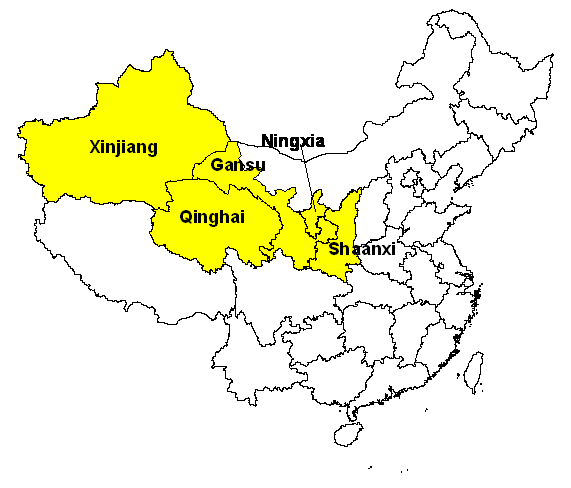
Figure 1. The geographic location of the five provincial districts in northwestern
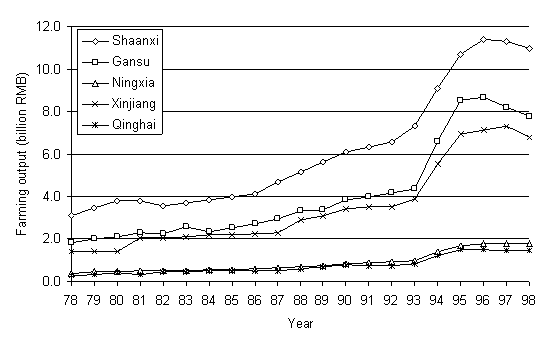
Figure 2. Time series plots of farming production in constant price for each provincial districts in northwestern China, during 1978 through 1998.
(Agricultural Systems, Volume 84, Issue 2, May 2005, Pages 155-169
Indexed by SCI,SSCI,
Impact factors of this journal
2003: 1.041 *
* Copyright ISI Journal Citation Report)